"Did the Suit Shrink at the Cleaners?" Stop Before Buying a Size Up!
Every track day enthusiast knows that chilling sensation: opening your gear bag right before the season opener, pulling on your FIA race suit, and feeling the zipper come to an abrupt, unforgiving halt right around your sternum and lower abdomen.
You stare into the mirror and try to rationalize: "Did the dry cleaner use too much heat? Did the Nomex fabric shrink?"
Before you know it, you are browsing racing supply stores with a 1,500-dollar size-up race suit sitting in your online checkout cart.
Hold that order. The issue is not that your passion has faded—it is simply that your core stabilizers and trunk muscles spent the off-season relaxing in office chairs instead of bracing against 1.3G cornering loads.
Why 3 cm of Waistline Costs You a Full Second of Lap Time
A tight waistline is far more than an aesthetic nuisance in motorsport; it directly degrades three crucial driving dynamics:
- Bucket Seat Disconnect: A thicker midsection prevents your pelvis and spine from sinking deeply into the molded bucket seat contours. When 1.2G+ lateral loads hit, your body slides, forcing you to death-grip the steering wheel just to brace yourself—instantly destroying fine steering touch and inducing forearm pump.
- Restricted Diaphragmatic Breathing: When a 6-point harness is cranked down against an expanded belly, shallow chest breathing takes over. Reduced oxygen saturation dulls split-second apex judgment and braking point calibration.
- Session 4 Stamina Crash: Morning sessions are powered by adrenaline. But by 3 PM, an exhausted core collapses forward under hard trail braking, turning precise brake pressure modulation into jerky, inconsistent inputs.
You don't need two grueling hours in a commercial gym every day. What track drivers need is not bulky bodybuilder mass, but dense isometric core stability and lactate threshold stamina.
The 3x10-Minute Protocol: Effortless Zippers & Endless Stamina
Commit just 10 minutes, three times a day: before leaving for work, during your lunch break, and before your evening shower.
[The 3x10-Minute Daily Circuit Conditioning Split]
* Morning 10 Min (Core & Pelvis)   : Deadbugs & Elbow Planks + Russian Twists (Lateral G-Tolerance)
* Midday 10 Min  (Neck & Mobility) : Isometric Neck Holds + Thoracic Rotations (Postural Alignment)
* Evening 10 Min (HIIT Circuit)    : Mountain Climbers & Squat Tabata Intervals (Rapid Fat Cut & Stamina)
1. [Morning - 10 Min] Core Activation & Lateral G Resistance
Start on your mat right after waking up:
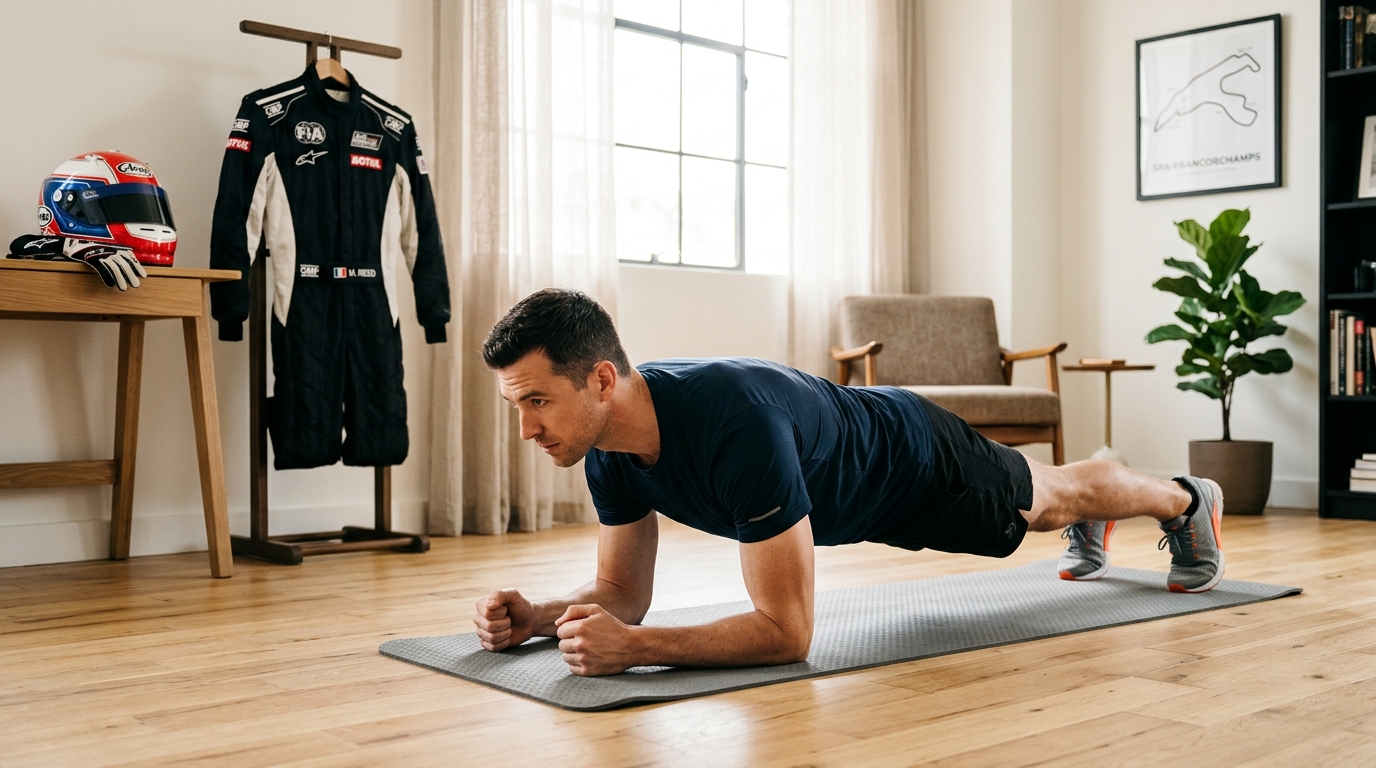
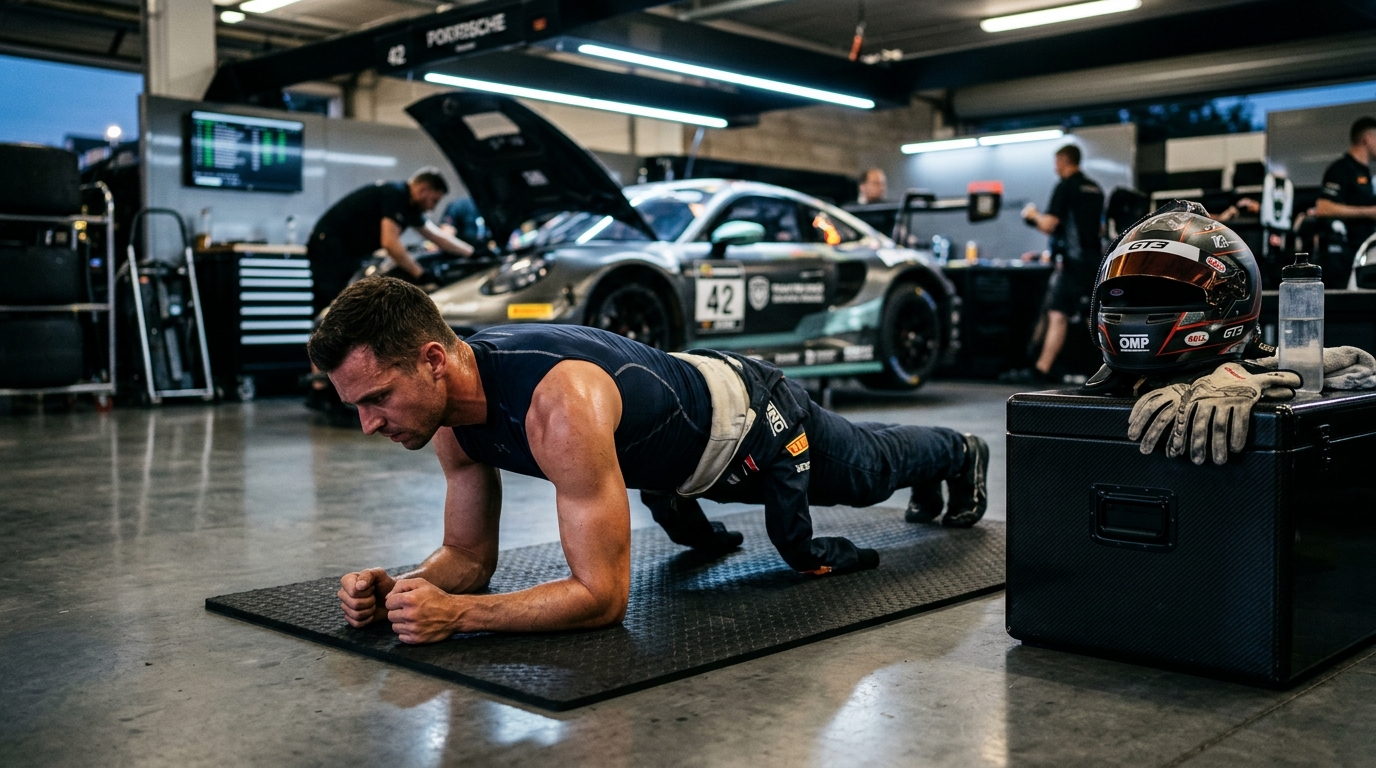
- Deadbugs & Plank Complex (4 Min): Lie on your back, alternating extended limbs while pressing your lumbar spine flat into the floor. Follow immediately with two 60-second elbow planks. This activates the transverse abdominis, pulling the lower abdomen inward.
- Russian Twists (3 Min): Knees bent, torso leaned back 45 degrees, rotating smoothly side to side. This tightens the obliques—the exact muscles that keep your upper torso centered through high-speed S-curves.
- Glute Bridges (3 Min): Fire up the posterior chain and hips. Strong glutes prevent your pelvis from slipping backward when stomping 80+ kg of threshold brake pedal pressure.
2. [Midday - 10 Min] Desktop Neck Bracing & Thoracic Mobility
Perform right at your desk or in a quiet office corner—zero equipment required:
- Isometric 4-Way Neck Holds (4 Min): Press your palm firmly against your forehead, occiput, and temples while pushing back with equal force for 10 seconds per direction (3 sets). This builds bulletproof neck strength to support a 1.4 kg helmet under braking and cornering Gs.
- Seated Thoracic Rotation & Chest Expansion (3 Min): Sit tall and rotate your ribcage gently side to side with deep exhalations. Reverses hunching, opens the diaphragm, and relieves abdominal bloat.
- Brisk 5-Flight Stair Climb (3 Min): Spikes heart rate to 125–135 bpm while firing quad stabilizers for threshold braking endurance.
3. [Evening - 10 Min] Fat-Shredding Tabata Racing Simulation
Right before your evening shower, simulate the sustained 155–170 bpm cardiovascular stress of a hot qualifying lap:
- 4-Minute High-Intensity Tabata (20s Max Effort / 10s Rest x 8 Rounds):
- Round 1: Mountain Climbers (Core trim & hip flexor snap)
- Round 2: Bodyweight Air Squats (Deep braking leg endurance)
- Round 3: Jumping Jacks or Burpees (Cardio oxygen capacity)
- Round 4: Plank Shoulder Taps (Rotational anti-torsion stability)
- Repeat for 2 full cycles (4 minutes total).
- Cooldown & Diaphragmatic Recovery (6 Min): Controlled breathing while stretching hamstrings, hip flexors, and lower back to restore nervous system equilibrium.
What Happens After Just 14 Days
Stick to this simple protocol for two weeks:
When you zip up your race suit on race morning, that formerly stubborn zipper will glide smoothly past your ribs all the way up to the collar velcro with zero resistance.
Even better is what happens on track:
- Your bucket seat and 6-point harness will lock onto you like a second skin, transmitting micro-slips from the rear tires straight to your hips.
- As the Session 4 checkered flag waves and other drivers retreat to the paddock exhausted with creeping lap times, you will still be fresh, alert, and setting your personal best (PB) on your final lap.
"You spend thousands on tires, pads, and telemetry to shave tenths. Dedicating just three 10-minute blocks to the driver mod is the highest-ROI upgrade in motorsport."
Before you spend a fortune on a larger racing suit, start your first 10-minute timer today!